A solar tracker is a mount that moves solar panels to follow the sun across the sky, instead of leaving them fixed at one angle on a roof or rack. Pointing the panels straight at the sun all day produces more electricity from the same number of panels, often 25 to 40% more than a fixed system. The gain is biggest early and late in the day and in northern winters, when the sun stays low. Trackers also keep the panels off the roof, and they can stow flat in high wind or tip to shed snow.
AllEarth Renewables has designed, engineered and built dual-axis trackers in Williston, Vermont, since 2005. Each pole-mounted tracker holds 20 or 24 panels, aims them using GPS and a hydraulic drive, and lays them flat when the wind picks up or the temperature drops below -10°F. More than 7,000 have been installed across the US. Each listing says what is made here and which parts are bought in.
See also solar panels, solar, lithium batteries and deep cycle batteries.
More types in this section ↓
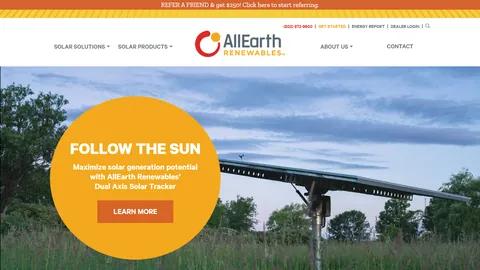
AllEarth Renewables makes the AllEarth Solar Tracker, a dual-axis, pole-mounted ground system for homes, farms, schools and businesses. Each tracker holds 20 or 24 solar panels, about 7.6 kW on average, on a galvanized steel mast. A GPS-guided controller and hydraulic drive turn the array a full 360 degrees and tilt it to follow the sun from sunrise to sunset. The company says that produces up to 40% more energy than a fixed rooftop system, with bifacial panels adding up to 40% more in Vermont winters. A wind sensor lays the array flat in gusts of 25 to 30 mph, and it also stows flat below -10°F. The tracker is wind-tunnel tested to 120 mph and works with most 60- and 72-cell panels. Foundations can be precast concrete, a steel riser or a helical pile. AllEarth also builds and runs community solar farms, sells power through on-site PPAs, and offers a RePower program to upgrade older trackers.
David Blittersdorf, who founded wind-instrument maker NRG Systems in 1982, started the company in 2005 as Earth Turbines to build small wind turbines, then switched to solar trackers and renamed it AllEarth Renewables. Its tracker was a Solar Power World top product of 2013. AllEarth has installed more than 7,000 trackers nationwide, over 3,000 of them in Vermont, and says its trackers are "Designed, Engineered & Built in Vermont."
Made in: Williston, VT (trackers designed, engineered, assembled and tested).
Bought in: solar panels, hydraulic drives, controller electronics and steel parts.
Source: AllEarth Solar Tracker, 2026 · AllEarth tracker info sheet, 2023 · Seven Days, 2011 · Vermont Business Magazine, checked 10/2026
Williston, VT
Solar tracker makers by state
- Vermont: AllEarth Renewables (Williston), dual-axis pole-mounted trackers for homes, farms and businesses
Types of solar trackers
Dual-axis trackers move both side to side and up and down, keeping the panels aimed squarely at the sun all day and all year. They produce the most energy per panel and are popular for homes, farms and small businesses with open land.
Single-axis trackers rotate long rows of panels from east to west on a single horizontal tube. They are the standard for large solar farms because they add most of the gain at lower cost per watt.
Pole-mounted trackers carry a whole array on one mast with a small footprint, leaving the ground underneath free for mowing, grazing or crops.
Active trackers use motors or hydraulics steered by GPS, sun sensors or astronomical calculations. Passive trackers use heated fluid to shift their balance, with no motor.
Choosing a solar tracker
- Make sure you have open land with clear southern exposure, and enough room between trackers that they don't shade each other.
- Compare the extra energy with the extra cost. A tracker usually costs more per panel than a fixed mount, so it pays off best where land or panel count is limited, or where electricity is expensive.
- Check wind and snow ratings and how the tracker protects itself, such as stowing flat in high wind and shedding snow.
- Look at the foundation: precast concrete, steel riser or helical pile, depending on your soil and frost depth.
- Ask about maintenance and warranty. Trackers have moving parts and drives, so local service and spare parts matter over a 25-year system life.
- Confirm panel compatibility with the sizes you plan to use, including larger and bifacial panels.
Reading "Made in USA" on solar trackers
Under FTC rules, an unqualified "Made in USA" claim means all or virtually all of the product is made here. Trackers are mostly steel, so many can be made largely in the US. Their motors, hydraulic drives, controllers and electronics, however, may come from overseas suppliers. The panels mounted on a tracker are a separate product with their own origin. For commercial and utility projects, federal domestic-content rules measure the US share of a tracker's steel and manufactured parts, so ask the maker for documentation on the specific system.
Know a USA-made company we missed?
If a company makes its products in the USA and is not listed, send us its website.
Add your site
Disclosures
Company names, logos and website previews belong to their owners and appear here only to identify the companies listed. If you own a listing and want an image changed or the listing removed, please contact us.
This site takes part in the Amazon Associates program and other affiliate programs, so some links earn us a commission at no extra cost to you. As an Amazon Associate I earn from qualifying purchases.
* This site does not have any relationship, business or personal, with any of the manufacturers listed. Our only affiliations are with the affiliate programs described above.
A company may be based in the USA while making some products elsewhere. Check the manufacturer's own site for where a specific product is made.