A solar panel starts as purified polysilicon. That is grown into ingots, sliced into thin wafers and processed into solar cells, which are then wired together, laminated between glass and a backsheet, and framed into a module. For more than a decade almost every step happened in Asia, and most "American" panels were US-assembled from imported cells. That is changing: new federal tax credits and domestic-content rules have brought cell and wafer factories back to the US, and a growing share of panels now use American parts beyond the final assembly.
Heliene builds modules in Mountain Iron and Rogers, Minnesota. Some of them use US cells from Georgia, and its all-American modules are made from Michigan polysilicon and wafers. Silfab Solar builds rooftop and commercial panels in Burlington, Washington, and is starting up its own cell production in Fort Mill, South Carolina. Each listing says where the cells, wafers and other parts come from, because the factory address alone doesn't tell you how American a panel is.
See also solar, lithium batteries, deep cycle batteries and battery chargers.
More types in this section ↓
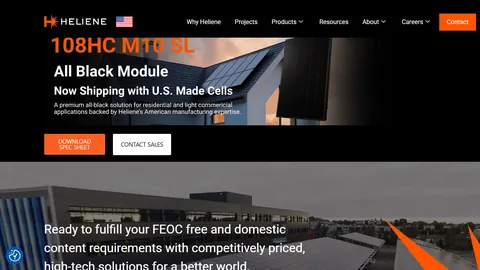
Heliene makes crystalline silicon solar modules for utility, commercial, community and residential projects. Its line runs from 108-cell rooftop panels to 156-cell utility modules. That includes PERC modules from about 380 to 595 watts, and newer N-type modules up to 650 watts, many of them bifacial so they also collect light reflected onto the back. The 108HC All-Black rooftop module, launched in 2026, is rated at 380 to 410 watts and has hail resistance up to 55 mm. It comes with 25-year product and performance warranties. Sunrun has signed on to buy it.
Heliene is based in Sault Ste. Marie, Ontario. It began making panels in the US in 2018 in a former module plant in Mountain Iron, Minnesota, across from a taconite mine, and later tripled that plant's size. In 2025 it opened a second factory in Rogers, bringing US capacity to 1.3 GW a year. For years Heliene used cells imported from India's Premier Energies. Since 2024 it has also bought US-made cells from Suniva in Georgia, and in 2025 it teamed with Hemlock Semiconductor, Corning and Suniva on the first all-American silicon module chain: Michigan polysilicon and wafers, Georgia cells and Minnesota assembly. Heliene says its 108HC All-Black is made with American polysilicon, ingots, wafers and cells. It also uses US-made Origami steel frames. A planned 1 GW cell plant in the Twin Cities was paused in 2025.
Made in: Mountain Iron, MN and Rogers, MN (module assembly); US cells from Norcross, GA; polysilicon and wafers from Michigan for its all-American modules.
Imported: cells for many modules, mostly from India.
Bought in: glass, junction boxes and some frames.
Source: Heliene, 2026 · pv magazine USA, 2025 · Solar Power World, 2025 · PV Tech, 2026 · Twin Cities Business, 2024 · Renewable Energy World, 2025, checked 10/2026
Rogers, MN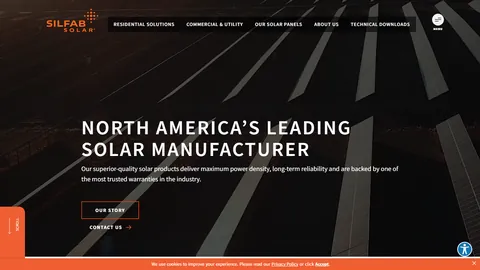
Silfab Solar makes solar modules for homes, businesses and utility projects. Its main product lines:
- Silfab Elite all-black rooftop panels (380 to 420 watts), built with back-contact cells and a conductive backsheet in place of front wiring
- Silfab Prime residential panels (370 to 440 watts)
- commercial modules up to 590 watts
- bifacial utility modules up to 640 watts at nearly 23% efficiency
Silfab is headquartered in Mississauga, Ontario. It has moved its module production to the US, on fully automated lines in Burlington, Washington, and calls its Elite series "exclusively made in the USA." In 2025 it opened a second plant in Fort Mill, South Carolina, planned for 1 GW of N-type cells and 1.3 GW of modules a year, with about 800 jobs. Module assembly there began in late 2025. Cell production was delayed after a chemical leak in March 2026 led to a state stop order and a compliance agreement. Production was then idled in August 2026 over material shortages. Silfab expected to start making cells in October 2026, after third-party safety tests.
Made in: Burlington, WA (modules); Fort Mill, SC (modules, with N-type cell production starting).
Imported: cells for most modules until Fort Mill's cell line is running.
Bought in: wafers, glass, frames and junction boxes.
Source: Silfab Solar, 2026 · Silfab 2024 impact report · Solar Power World, Aug 2026 · GreenLancer, 2026, checked 10/2026
Burlington, WA
Solar panel makers by state
- Minnesota: Heliene (Mountain Iron and Rogers), residential, commercial and utility modules, some with US cells
- South Carolina: Silfab Solar (Fort Mill), modules, with N-type cell production starting
- Washington: Silfab Solar (Burlington), Elite and Prime rooftop panels and commercial modules
Types of solar panels
Monocrystalline silicon panels are the standard for homes and businesses. They are cut from single-crystal wafers and are dark and efficient, typically 20 to 23%.
PERC, N-type (TOPCon) and back-contact cells are successive cell designs. PERC was the workhorse of the last decade. N-type cells hold up better in heat and degrade more slowly. Back-contact cells move the wiring to the rear for more output and a cleaner, all-black look.
Bifacial panels collect light on both sides, picking up sunlight reflected off the ground or a light-colored roof. They are common in ground-mount and utility projects.
All-black residential panels use black backsheets and frames to blend in on a roof.
Thin-film panels deposit a thin semiconductor layer on glass instead of using silicon wafers. They are used mostly in large utility projects.
Portable and off-grid panels are small rigid or folding panels for RVs, boats, cabins and battery charging.
Choosing solar panels
- Compare wattage and efficiency. Higher efficiency gets more power from limited roof space.
- Check the warranties. Look for a 25-year product warranty and a performance guarantee that limits yearly degradation, about 0.5% a year or better.
- Look at the temperature coefficient. A lower number means less power lost on hot days.
- Consider hail, snow and wind ratings if you live where storms are common.
- Ask about domestic content. Commercial and utility projects can earn larger federal tax credits when enough of the panel is made in the US, and some programs require US-made equipment.
- Pick a maker likely to be around for the life of the warranty. Several US panel factories have opened and closed in the last few years.
Reading "Made in USA" on solar panels
Under FTC rules, an unqualified "Made in USA" claim means all or virtually all of the product is made here. The cell is the most valuable part of a silicon panel, and most panels assembled in the US still use cells, wafers or polysilicon from Asia. "Manufactured in the USA" often means only the final assembly. Federal domestic-content rules measure the share of a panel's manufactured parts made in the US, and a module may qualify at well under 100%. Ask where the cells and wafers were made, not just where the panel was built, and check the documents for the specific model.
Know a USA-made company we missed?
If a company makes its products in the USA and is not listed, send us its website.
Add your site
Disclosures
Company names, logos and website previews belong to their owners and appear here only to identify the companies listed. If you own a listing and want an image changed or the listing removed, please contact us.
This site takes part in the Amazon Associates program and other affiliate programs, so some links earn us a commission at no extra cost to you. As an Amazon Associate I earn from qualifying purchases.
* This site does not have any relationship, business or personal, with any of the manufacturers listed. Our only affiliations are with the affiliate programs described above.
A company may be based in the USA while making some products elsewhere. Check the manufacturer's own site for where a specific product is made.