Radio is one of the oldest branches of American electronics. Companies such as Collins, Hallicrafters, Heathkit, Drake and Ten-Tec once filled ham shacks and shortwave listening posts across the country. Today most consumer radios, two-way handhelds and ham transceivers are built in Asia. A few American companies still design and build radios here, mostly for ham radio operators, government listening stations and other serious users who value performance and repairability over price.
Ten-Tec has built high-frequency (HF) ham transceivers and receivers since 1968. Its current radios range from low-power QRP rigs to 100-watt transceivers, plus the RX-340 commercial receiver. All of them are built in Dayton, Ohio, where the company is now developing its Phoenix software-defined (SDR) transceiver. Even American-built radios use chips and many electronic parts made overseas, so each listing says what is made here and what is bought in.
See also electronic components, batteries, solar and night vision.
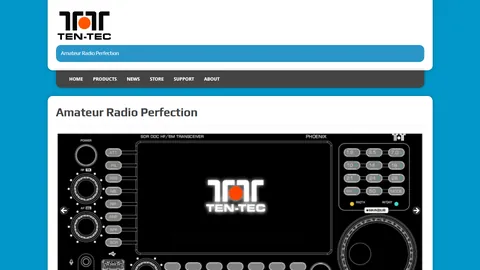
Ten-Tec makes HF amateur (ham) radio transceivers, receivers and accessories. Its line includes:
- the 588 OMNI-VII+ and 599AT EAGLE 100-watt transceivers
- the 539 Argonaut VI, 507 Patriot and 506 Rebel low-power (QRP) radios
- the RX-340 and RX-331 commercial HF receivers used by government and monitoring stations
- amplifiers, antenna tuners, Alpha wattmeters and dummy loads
Its newest radio is the Model 594 Phoenix, a direct-sampling SDR transceiver that covers 300 kHz to 55 MHz at 5 to 100 watts. It has dual receivers, a built-in automatic antenna tuner, a 5.5-inch AMOLED display, and a built-in web server for remote operation. Ten-Tec also repairs and services current and older Ten-Tec radios.
Ten-Tec was founded in 1968 in Sevierville, Tennessee, and was one of the last American makers of ham transceivers. After a merger with RF Concepts and a sale to RKR Designs, Ohio amplifier maker Dishtronix bought Ten-Tec's assets in January 2016. Owner Mike Dishop, N8WFF, restarted production of the RX-340 and RX-331 and launched the OMNI-VII+. At Hamvention 2025 the company introduced the Phoenix as "all US made," selling the first 100 units through a pre-order club. All production now takes place in a single plant in Dayton.
Made in: Dayton, OH (radios designed, built, tested and repaired).
Bought in: semiconductors and other electronic components.
Source: Ten-Tec, 2026 · CQ.sk, 2026 · ARRL, 2016 · RadioReference forum, 2025, checked 10/2026
Dayton, OH
Radio makers by state
- Ohio: Ten-Tec (Dayton), HF amateur transceivers, QRP radios and RX-340 commercial receivers
Types of radios
HF transceivers transmit and receive on the shortwave ham bands, from 160 to 10 meters. With a good antenna, they can reach around the world by bouncing signals off the ionosphere.
QRP radios are low-power transceivers, usually 5 watts or less. They're small and light, which makes them popular for portable and backpack operating, Parks on the Air activations and Morse code (CW).
Software-defined radios (SDR) digitize the signal right at the antenna and do the filtering and decoding in software. They offer sharp filters, spectrum displays, multiple receivers and remote operation over the internet.
Communications receivers only listen. Shortwave listeners, government monitoring stations and broadcasters use them to receive signals from around the world.
VHF/UHF and two-way radios cover shorter local distances. They include ham handhelds and mobiles, business radios, and public safety and marine radios.
Amplifiers, tuners and accessories boost transmit power, match a radio to its antenna, and measure power and SWR.
Choosing a radio
- Get licensed first. Transmitting on ham bands requires an FCC amateur license (Technician, General or Extra), but listening requires none.
- Match the radio to how you'll operate: a base station at home, a mobile radio in your vehicle, or a QRP rig for portable use.
- Look at receiver performance, such as sensitivity, selectivity and how well it handles strong nearby signals. That matters more than features on crowded bands.
- Check which modes you need: voice (SSB, AM, FM), CW and digital modes such as FT8. Some newer radios generate digital modes internally, with no computer sound card needed.
- Plan for power and antenna. A 100-watt radio needs a 13.8-volt supply rated for about 20 amps, and the antenna matters as much as the radio.
- Ask about service. A US maker that repairs its own radios and keeps parts on hand can keep a radio on the air for decades.
Reading "Made in USA" on radios
Under FTC rules, an unqualified "Made in USA" claim means all or virtually all of the product is made here. Radios built in the US are usually designed, assembled, tuned and tested here, but the chips, displays and many other electronic parts come from overseas suppliers. Some well-known American radio brand names are now made entirely in Asia. Check where the specific model is built, not just where the brand began.
Know a USA-made company we missed?
If a company makes its products in the USA and is not listed, send us its website.
Add your site
Disclosures
Company names, logos and website previews belong to their owners and appear here only to identify the companies listed. If you own a listing and want an image changed or the listing removed, please contact us.
This site takes part in the Amazon Associates program and other affiliate programs, so some links earn us a commission at no extra cost to you. As an Amazon Associate I earn from qualifying purchases.
* This site does not have any relationship, business or personal, with any of the manufacturers listed. Our only affiliations are with the affiliate programs described above.
A company may be based in the USA while making some products elsewhere. Check the manufacturer's own site for where a specific product is made.