This page lists American companies that build loudspeakers for home music and theater systems, from floor-standing and bookshelf speakers to center channels, surrounds and powered subwoofers.
The US makers here take very different approaches. Some use thin flat panels instead of cones, some spread sound in every direction from a single driver, some align every driver in time and phase, and some build machined aluminum cabinets around drivers they design themselves. Most build their own cabinets and many make their own drivers, but parts such as crossover capacitors, magnets or some drivers may come from other makers. Each listing names the US workshop or plant, the work done there and any imported or bought-in parts a source states.
For power amplifiers see Amplifiers, and for preamps, DACs and surround processors see Processors.
More types in this section ↓
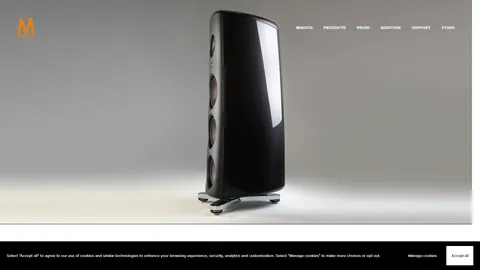
Magico makes ultra-high-end loudspeakers sold through specialist dealers: the flagship M Series (M2, M3, M6, M7 and M9), the S Series (S2, S3, S5 and S7 plus the SSub subwoofer and SCC center), the A Series (A1, A3, A5, ACC center and ASub) and the Titan 15 powered subwoofer with dual opposed drivers in a sealed aluminum enclosure. Magico has built aluminum enclosures since 1994, using constrained-layer damping to remove cabinet resonance, and is one of the few high-end speaker companies that designs its own drivers: MBe-1 beryllium tweeters with its MR-1 motor, and Nano-Tec cones with carbon nanotube skins over a Rohacell foam core. Its Elliptical Symmetry Crossover (ESXO) uses very steep, symmetrical filter slopes, modeled with software Magico writes itself.
Made in: Hayward, CA (a 30,000 sq ft campus where its craftsmen, technicians and machinists design, prototype, machine enclosure parts, build drivers and assemble and test each speaker; the company says it makes the whole product without outsourcing).
Imported: all crossover parts (capacitors and copper foil inductors) are made by Mundorf in Cologne, Germany.
Source: Magico facility · Magico crossovers, 2026 · Stereophile, 2015, checked 10/2026
Hayward, CAMagnepan makes Magneplanar loudspeakers: thin, flat-panel speakers that drive a large Mylar diaphragm with a magnetic field instead of using cones, plus true ribbon tweeters. The line includes the LRS+, .7, 1.7i, 2.7i, 3.7i, 20.7 and 30.7 floor-standing speakers, the Mini Maggie desktop system, the DWM bass panel and the CCR, CC5, MC1 and MMG C center and surround models. Jim Winey invented the Magneplanar in 1969, more than 200,000 pairs have been sold, and buyers can order through dealers or direct from the factory.
Made in: White Bear Lake, MN (a 50,000 sq ft plant: panel frames are cut from MDF on a CNC machine in the wood shop, thin aluminum conductor strips are attached by hand to the Mylar film, and magnets and panels are assembled and finished in-house). Magnepan says its speakers are American-made with virtually all American parts.
Source: Magnepan About Us, 2026, checked 10/2026
White Bear Lake, MN
Ohm Acoustics makes omnidirectional loudspeakers built around Lincoln Walsh's Coherent Line Source driver, which plays most of the range from one driver and spreads sound 360 degrees, so stereo images stay focused from almost anywhere in the room. Current models include the Walsh Tall series (MicroWalsh and the 1000 through 5000), MicroWalsh Short, Walsh Shelf center channel, Walsh wall-mounted surround, the F5 and a dual 12-inch subwoofer, in walnut, cherry, maple, oak or sapele veneer. Ohm has sold factory-direct since 1999 with a 120-day home trial, and has built more than 120,000 speakers since the 1970s.
Made in: Connecticut (company address Thomaston, CT; a 2024 factory visit found cabinets cut, glued, veneered and oiled by hand, grilles and driver covers made and painted, and drivers fitted into their metal cylinders at its Bridgeport, CT shop). The Walsh drivers were made in a separate factory in Brooklyn, NY, where Ohm was based until 2023.
Source: Decibel Hi Fi factory visit, 2024 · Ohm Speakers, 2026, checked 10/2026
Thomaston, CT
Vandersteen Audio makes time- and phase-correct loudspeakers, which use first-order crossovers so that every driver's sound reaches the listener in step, sold through hand-picked dealers. The line runs from the Model 1Ci+ (in production since 1983) and Model 2Ce Signature III (since 1977, one of the best-selling high-end speakers ever made) to the Quatro Wood CT, the KENTO Carbon and the flagship Model Seven Mk II, plus the SUB THREE powered subwoofer (325-watt amplifier, three 8-inch drivers in cast aluminum baskets), center, surround and on-wall speakers and high-pass amplifiers. Its top models use patented Perfect-Piston drivers with a carbon fiber and balsa wood sandwich cone, and many models have built-in powered subwoofers with room EQ. Vandersteen still services every product it has built since 1980 and can rebuild most drivers.
Made in: Hanford, CA (all products designed and manufactured there).
Bought in: the KENTO Carbon's side-firing 9-inch Counterforce bass drivers are built for Vandersteen by an outside maker.
Source: Vandersteen About Us · KENTO Carbon, 2026, checked 10/2026
Hanford, CA
Speaker makers by state
- California: Magico (Hayward), aluminum-cabinet speakers and subwoofers
- California: Vandersteen Audio (Hanford), time-and-phase-correct speakers and subwoofers
- Connecticut: Ohm Speakers (Thomaston), omnidirectional Walsh speakers
- Minnesota: Magnepan (White Bear Lake), planar-magnetic panel speakers
Types of speakers on this page
- Planar-magnetic panels: a large, very light film diaphragm is driven across its whole surface by magnets. Panels give open, detailed sound and radiate from both front and back, so they need space from the wall behind them.
- Omnidirectional: the driver sends sound out in all directions, so the stereo image holds up across the room instead of in one seat.
- Time and phase correct: first-order crossovers and stepped driver positions let the sound from every driver reach your ears at the same moment, keeping the waveform close to the original recording.
- Dynamic cone and dome: the familiar design, refined with stiff cone materials such as carbon fiber, beryllium and carbon nanotubes, and with rigid, damped cabinets that keep the box from adding its own sound.
Choosing speakers
- Room size: match the speaker to the room. Large floor-standing speakers and panels need space to breathe; smaller rooms often sound better with compact speakers and a subwoofer.
- Placement: panels and rear-firing designs need distance from the wall, while some speakers are built to sit closer. Check the maker's placement guide.
- Amplifier: check sensitivity and impedance. Low-sensitivity or low-impedance speakers need a more powerful amplifier.
- Bass: speakers with built-in powered subwoofers or room EQ can tame bass peaks that a room adds.
- Listening: many makers offer home trials or dealer auditions. Hearing speakers in your own room is the best test.
Reading "Made in USA" on speakers
Under Federal Trade Commission rules, a plain "Made in USA" claim means all or virtually all of the product is made here. Some US speaker makers build nearly everything themselves; others buy crossover parts, magnets, drivers or amplifier modules from other countries. The listings on this page say which work happens in the US and name imported parts when a source states them.
Know a USA-made company we missed?
If a company makes its products in the USA and is not listed, send us its website.
Add your site
Disclosures
Company names, logos and website previews belong to their owners and appear here only to identify the companies listed. If you own a listing and want an image changed or the listing removed, please contact us.
This site takes part in the Amazon Associates program and other affiliate programs, so some links earn us a commission at no extra cost to you. As an Amazon Associate I earn from qualifying purchases.
* This site does not have any relationship, business or personal, with any of the manufacturers listed. Our only affiliations are with the affiliate programs described above.
A company may be based in the USA while making some products elsewhere. Check the manufacturer's own site for where a specific product is made.